Quick Specs
By Integrating within Ansys Workbench and its own native-user interface, Ansys Autodyn has long led the industry in ease of use, enabling you to produce accurate results with the least amount of time and effort.
Ansys empowers the next generation of engineers
Students get free access to world-class simulation software.
Design your future
Connect with Ansys to explore how simulation can power your next breakthrough.
Students get free access to world-class simulation software.
Connect with Ansys to explore how simulation can power your next breakthrough.
Simulate the response of materials to events ranging from short duration severe mechanical loadings, high pressures and even explosions. Ansys Autodyn provides advanced solution methods without compromising ease of use.
Ansys Autodyn makes it easy to quickly understand and simulate large material deformation or failure. Autodyn has a range of models to represent complex physical phenomena such as the interaction of liquids, solids and gases; the phase transitions of materials; and the propagation of shock waves.

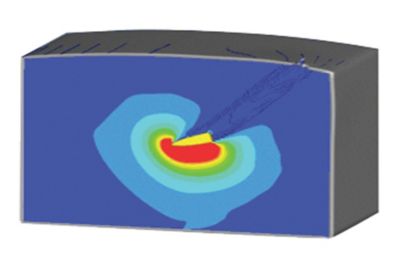
By Integrating within Ansys Workbench and its own native-user interface, Ansys Autodyn has long led the industry in ease of use, enabling you to produce accurate results with the least amount of time and effort.
Technology from Ansys helps to optimize the precise timing of delayed detonations to get the biggest bang for the buck in the mining industry.

The key to optimal blast performance is a series of well-planned explosions. Rows of explosive-filled holes are set off with electronic detonators in a precise-delay timing sequence, measured in milliseconds.
In today’s mining operations, explosive blasts are just as much about precision control as brute force. For efficiency, miners must use enough explosives to fragment and move as much material as possible—but the amount of explosive energy is constrained by budgets and limits on blast vibrations. If timed correctly, shock waves reinforce and amplify one another to produce maximum fragmentation and movement of rock, ore, coal and other materials
With so many variables, mining operators must determine the right detonation delay, often through trial and error. Even after months of experimentation, many companies settle on a delay that gets the job done satisfactorily rather than finding the optimal delay. The largest supplier of explosives in the industry, Orica, is studying precise-delay timing, using Ansys Autodyn nonlinear explicit dynamics software for risk assessments of explosives manufacturing, to give the mining industry a better alternative
The smooth particle hydrodynamics (SPH) solver completes the picture to provide everything needed for explicit analysis. Ansys Autodyn lets you select from different solver technologies so the most effective solver can be used for a given part of the model.
The Lagrangian FE solvers enable fast and efficient solutions when looking at structural components subjected to shock loading and large deformations. Two Euler solver formulations give you the ability to model high speed fluid flow, as well as an alternative way to simulate extreme plastic flow of solid materials.
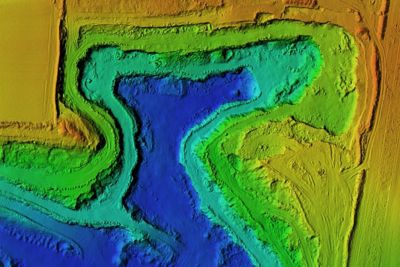
Ansys Autodyn offers a way to simulate your experiment set up so you can reduce and simplify physical testing
It's vital to Ansys that all users, including those with disabilities, can access our products. As such, we endeavor to follow accessibility requirements based on the US Access Board (Section 508), Web Content Accessibility Guidelines (WCAG), and the current format of the Voluntary Product Accessibility Template (VPAT).
If you're facing engineering challenges, our team is here to assist. With a wealth of experience and a commitment to innovation, we invite you to reach out to us. Let's collaborate to turn your engineering obstacles into opportunities for growth and success. Contact us today to start the conversation.