|
|
||
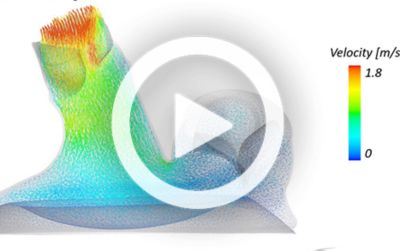
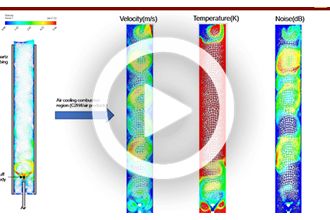
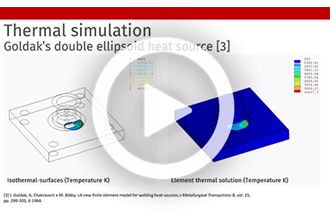
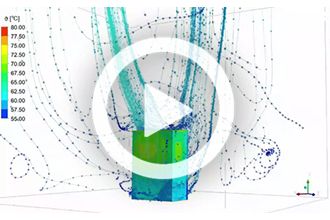
BTU-CottbusA member of the Rolls Royce Research University Technology Centres, BTU-Cottbus, Department of Structural Mechanics and Vehicle Vibration Technology studies specialized multidisciplinary process integration, particularly the physics of highly thermal-loaded turbine parts. In making gas turbine engines more efficient, turbine blades suffer from increasingly high heat load. This demands improvements in the internal cooling system and a better understanding of both levels and distributions of internal heat transfer. A typical approach is casting geometrically simple angled low-blockage ribs on cooling channel walls, often in combination with film cooling. This knowledge can be used to guide the overall design, such as achieving high levels of heat transfer where required. Complex internal geometry is reduced to simple 1-D flow channel networks, enabling rapid simulation of several geometry variations. Using this thermal field, structural simulation and lifting prediction can be estimated. |
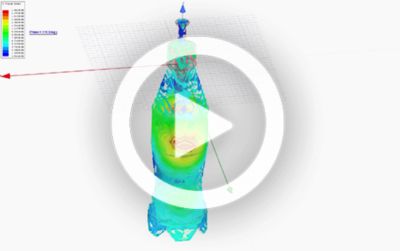
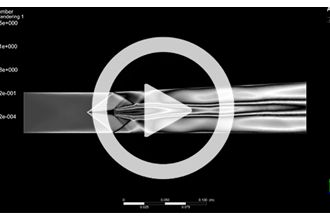
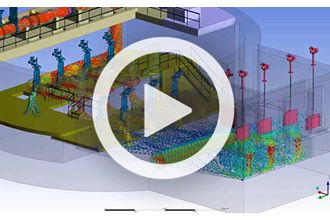
Mott MacDonaldManagement, engineering and development firm Mott MacDonald applied ANSYS Autodyn to simulate complex fluid-structure interactions inside a metro station, taking into account nonlinear behavior and impacts. These modern train stations often incorporate glass screens along the platform edge, which help to ensure passenger safety as well as contribute to the station's air flow and thermodynamics. In the event of explosion, the glass could be damaged, sending flying shards throughout public areas. Autodyn enabled studying the effects of explosions in detail to find solutions that mitigate the consequences. The technology's flexibility and efficiency provided a major advantage over other explosion-prediction methods, which are less accurate and of limited validity. |
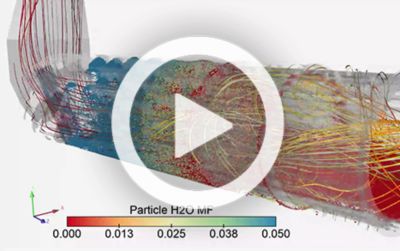
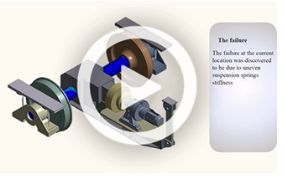
Trane – Ingersoll RandTrane–Ingersoll Rand used fully coupled structural–acoustic sound modeling to develop HVAC compressor design concepts. The team built a comprehensive model of the multipath structural/acoustic responsiveness of the reciprocating compressor; simulation encompassed numerous fluid domains and structural components internal and external to the compressor. Utilizing the FSI interface between structural and acoustical domains, the team conducted the entire process within a single-software platform, making simulation more efficient as well as expanding its scope. This complete-system simulation revealed energy paths not previously considered, enabling engineers to identify the root causes of excessive vibration and sound, and to optimize critical design parameters. |
Software used: |